


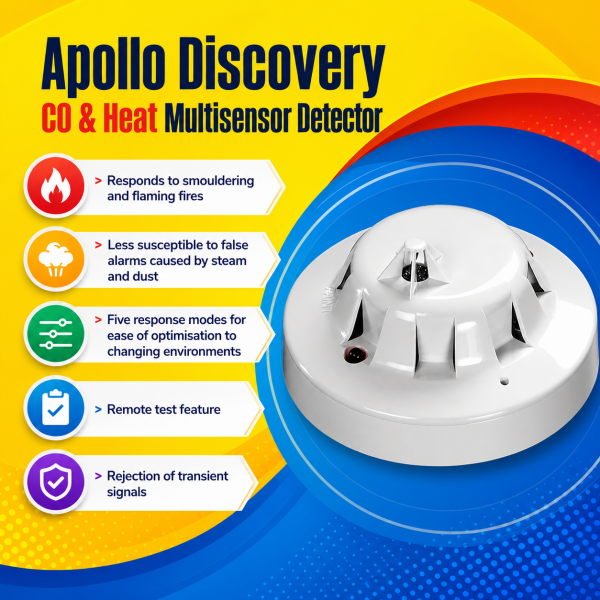
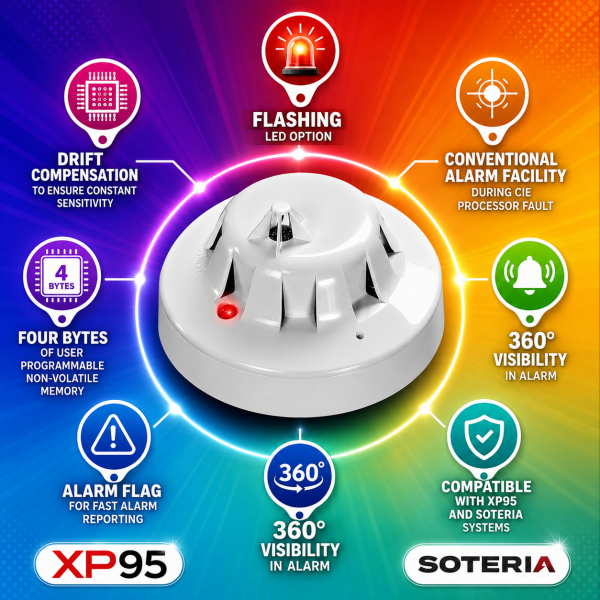
Apollo 58000-305APO Discovery Series CO and Heat Multi-Sensor Detector, White
£139.99 Original price was: £139.99.£119.25Current price is: £119.25.
Key Features – 58000-305APO
- Responds to smouldering and flaming fires
- Less susceptible to false alarms caused by steam and dust
- Five response modes for ease of optimisation to changing environments
- Remote test feature
- Rejection of transient signals
- Flashing LED option
- Drift compensation to ensure constant sensitivity
- Four bytes of user programmable non-volatile memory
- Alarm flag for fast alarm reporting
- Conventional alarm facility during CIE processor fault
- 360° visibility in alarm
- Compatible with XP95 and SOTERIA systems
- Description
Description
Apollo Discovery CO & Heat Multisensor Detector
Part Number: 58000-305APO
The Discovery CO/Heat Multisensor Detector contains a CO detection cell and a thermistor temperature sensor whose outputs are combined to give the final analogue value. The way in which the signals from the two sensors are combined depends on the response mode selected.
The CO/Heat Multisensor detects the presence of carbon monoxide or heat or a combination of both.
The Multisensor construction is similar to that of a CO detector but uses a different lid in order to expose the thermistor to the surrounding air.
The signals from the CO sensing cell and the thermistor are independent and represent the amount of CO or the temperature present in the vicinity of the detector.
When the detector is used in heat only mode (Mode 5), it operates as an A1R rate-of-rise heat detector with a static threshold of 58°C.
Operation
Discovery detectors are designed to be operated with purpose-designed control and indicating equipment that makes full use of their features.
Discovery can, however, be connected to any fire control panel which can operate existing ranges of Apollo analogue addressable detectors, with the previously noted rule that the control and indicating equipment must not have a drift algorithm operating on Discovery devices.
Contact the fire control panel manufacturer for guidance.
Device Addressing
Response Modes
Mode 1 – Very high sensitivity to carbon monoxide combined with moderate sensitivity to heat. This gives a high overall sensitivity to both smouldering and flaming fires.
Mode 2 – Reports the presence of carbon monoxide only.
Mode 3 – Moderate sensitivity to carbon monoxide combined with moderate sensitivity to heat. Used for general applications.
Mode 4 – Lower than normal carbon monoxide sensitivity combined with moderate heat sensitivity, suitable for areas where a certain amount of carbon monoxide might be considered normal.
Mode 5 – No response to carbon monoxide and acts as a rate-of-rise heat detector.
Notes
If the Multisensor is to be used in Mode 5, heat detector spacing and coverage should be applied. Observe the recommendations of BS 5839-1 or other applicable code.
The notes on carbon monoxide detectors on pages 16–17, particularly concerning application, limitations and precautions, should be read carefully.
In situ testing of the multisensor detector should be carried out as for CO detectors in response mode 2 and for heat detectors in response mode 5. Both CO and heat sensors must be tested in modes 1, 3 and 4.
The CO/Heat Multisensor Detector cannot be tested with Discovery Test Set.
Communication
Discovery uses a digital communications protocol developed from the XP95 protocol. It allows communication in three different modes:
- Normal Mode
- Read Mode
- Write Mode
This allows a more extensive exchange of information and commands than previous analogue addressable ranges. Discovery can also store data in non-volatile memory.
Normal Mode is identical to the XP95 protocol, except that the five additional analogue value bits in the XP95 protocol extension have been re-defined so the fire control panel can distinguish between Discovery and XP95 devices.
Read Mode is used to check information stored in the non-volatile memory of each detector. It is accessed by using a simple extension to the Normal mode communication method from the fire control panel to the detector.
Write Mode allows the fire control panel to write information to the detector by extending the communication method in the same way as in Read mode. During Read or Write modes, a detector can signal an alarm by means of the alarm flag and alarm address bits.
Discovery detectors are compatible with XP95 and Soteria.
It should be noted that Discovery features will not be available when Discovery is used with XP95 fire control panels. Fire control panels with drift compensation algorithms should disable the algorithms when communicating with Discovery.
For fire control panels running CoreProtocol, refer to the fire control panel manufacturer’s operating instructions.
Product Specification
Specifications are given at 23°C and 50% relative humidity unless stated otherwise.
| Product Code: | 58000-305 |
| Detector Principle: | CO: Ambient Carbon Monoxide level – Heat: Temperature dependent resistance |
| Supply Wiring: | Two-wire supply, polarity sensitive |
| Terminal Functions: | L1 -ve & L2 +ve: Supply in and out connections, +R: Remote indicator positive connection (internal 2.2kΩ resistance to positive) |
| Operating voltage: | 17-28V DC |
| Communication protocol: | Apollo Discovery 5-9V to peak to peak |
| Quiescent current: | 400µA |
| Power-up surge current: | 1mA |
| Maximum power-up time: | 10 seconds |
| Alarm current, LED illuminated: | 3.5mA |
| Remote output characteristics: | Connects to positive line through 4.5kΩ (5mA maximum) |
| Sampling Frequency: | 1 per seconds |
| Clean-air analogue value: | 25±2 |
| Alarm level analogue value: | 55 |
| Alarm indicator: | 2 red Light Emitting Diodes (LEDs); illuminated red in alarm; optional remote LED |
| Storage temperature: | Continuous +10°C to +30°C |
| Operating temperature: | Continuous: 0°C to 50°C – Transient: -20°C to +55°C (no condensation or icing) |
| Operating pressure: | Atmospheric pressure ±10% |
| Humidity: | Continuous 15 to 90% RH; Transient 0 to 99% RH |
| Effect of temperature on CO cell: | Less than 15% change in sensitivity over rated range |
| Effect of wind on CO cell: | None |
| Maximum CO cell life: | 7 Years (assumes regular checks are satisfactory |
| Transport pressure: | If air freighted this detector should be carried in a pressurised hold |
| Vibration, Impact & Shock: | To EN54 |
| IP rating: | 44 |
| Dimensions (D x H): | 100 x 54mm, 100 x 60mm (Height in Base) |
| Weight: | Detector: 105g – Detector in Base: 160g |
| Materials | Housing: White polycarbonate V-0 rated to UL94 – Terminals: Nickel plated stainless steel |
